

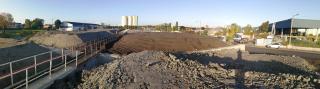

Since its creation, the vocation of AWS France (French subsidiary of Group De Cloedt) has been to benefit from the possibilities of treatments and valuations in Flanders. This valuable proposition is an alternative to the "bury all" strategy in storage facilities (ISD). However, the French treatment system regularly organizes to have this waste accepted at a lower cost in ISD, instead of seeing it recovered in Belgium. To sustain its existence, AWS France is forced to work on particular or "new" issues not yet taken into account in the French system for managing polluted soils. To do this, AWS France relies on BIOTERRA's expertise in Genk. In this way, and given BIOTERRA's technological advances, AWS France is able to meet the adaptation and evolution requirements of the French market.
It is in the context of a problem revealed in 2021 related to the presence of pyrite in soils that AWS France, in synergy with BIOTERRA, was able to demonstrate its technical, regulatory and logistical skills.
For the past 3 years, AWS France has been working on the largest European construction site today: the Grand Paris Express (GPE). This project provides for the creation of 4 new metro lines, and the extension of two of them, over a total length of 200 km. The digging depth can reach 35m for the construction of tunnels, station boxes and ancillary structures. Work began in 2017; Deliveries will be spread out until approximately 2040. They will generate several million tons of excavated material (the vast majority of which is inert).
In 2021, analyses of controls carried out next to an Inert Waste Storage Facility (ISDI in French) showed significant acidification of the water table. Investigations of causes have shown the presence of pyrite in the soils that were brought on site. Not that the excavated material does not meet the criteria for admission to an ISDI, but this pyrite (an iron sulphide) oxidizes when the soil is excavated and exposed to air. A chemical reaction then takes place, and the waste has an evolutionary character not compatible with burial in ISDI (the waste is therefore no longer inert).
The Société du Grand Paris (SGP), manager of the GPE project, could not find a solution to this emerging problem except at excessively high costs. AWS France was able to respond in a short time by:
It is on behalf of its client EIFFAGE, an earthmoving company in charge of a section of line 15 (East Paris), then faced with this pyrite problem, that AWS France provided its expertise and an appropriate solution with BIOTERRA's physico-chemical treatment unit. In the highlights, we managed to evacuate 5,200 Tons per week, with barges whose capacity does not exceed 750 Tons (gauges "Canal du Nord")). This is a first and a record for this type of evacuation service to Belgium from Paris.
These evacuations, from the construction site to their final treatment, were followed without failure in the TRex traceability software of the Société du Grand Paris. Waybills were issued, managed, and validated until final processing. The treatment of the excavated material has also been controlled and validated by the Société du Grand Paris (SGP).
From now on, AWS France and BIOTERRA are listed as preferred outlets in the consultation documents of construction companies for future metro lines. Enough to ensure gratifying prospects for the years to come!


