

Our vessels set sail at a certain pace of 10 knots, making their way to one of the concessions. Once in position, the suction pipe is lowered to the seabed, reaching depths of 35 meters. The drag head, which is equipped on the suction pipe, glides over the seabed. Its teeth like parts help break up the firm bottom. The dredge pump and the jet pump on the drag head, spring into action. The dredge pump sucks up the mixture from the seabed, while the jet pump creates high-velocity jet of water, ensuring efficient dredging.
As the mixture enters the drag head, a grid filters out the largest stones. This allows for the selection of specific sizes of aggregates, meeting the unique requirements of each project. Stones are strategically offloaded overboard. Vessels such as the DC Orisant and DC Ostend that mainly dredge gravel, throw away the excess sand.
The dredging ships load until fully packed, strategically loading to the dredging mark. Carefully managed, they go beyond the usual capacity, maximizing their efficiency. Before setting sail to the destination, it's essential to drain excess water. This process optimizes cargo capacity and ensures a smooth and safe journey.
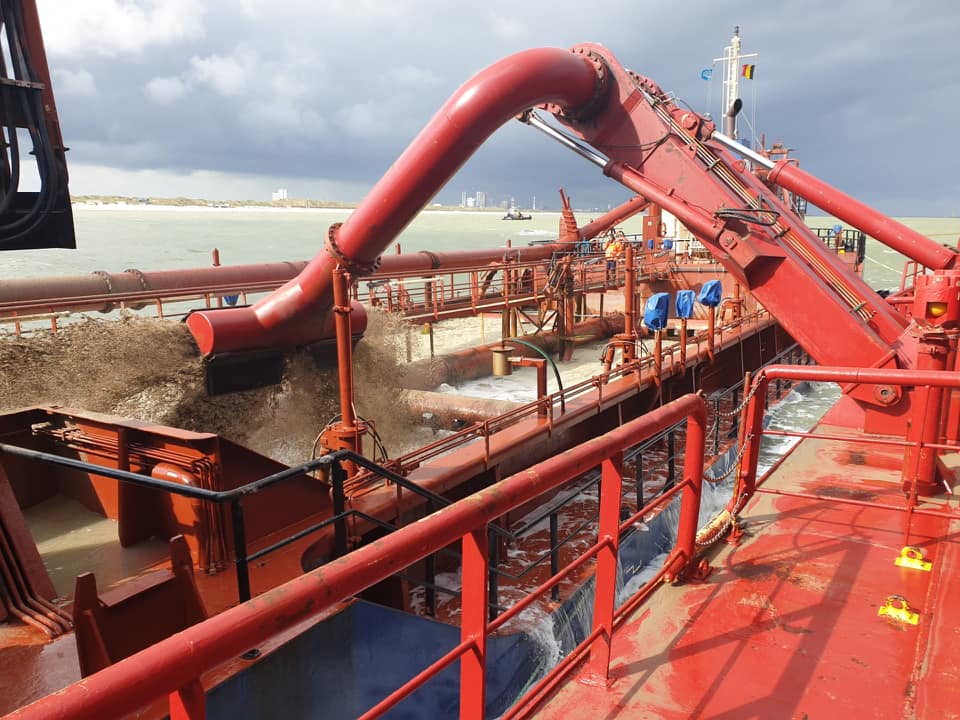
Upon reaching their destination, the unloading process begins. Unloading of the cargo can be done in 4 different ways. Some are only capable to unload wet, others only dry on shore. DC Rio is one of the ships that can do all of it. To unload wet, the cargo will be further wetted using the jet pump. It can be pressed through a floating pipe via the bow coupling, via rainbowing or via wet transshipment in smaller vessels. Unloading of the dry cargo is done by means of an bucket wheel unloader, which travels along the hopper via a chain drive system. The cargo is dumped onto a conveyor belt (35m - 65m). In case of unforeseen circumstances, bottom doors serve as emergency facilities, enabling a swift and secure unloading process beneath the ship. This can also be considered as a 5th unloading technique.
Dredging showcases the careful work of our crews, emphasizing their dedication and expertise. As we navigate through the depths, we take satisfaction in shaping the maritime landscape and contributing to the progress of our industry.
